Paying it forward: How employees earned student loan forgiveness through our mission-driven work
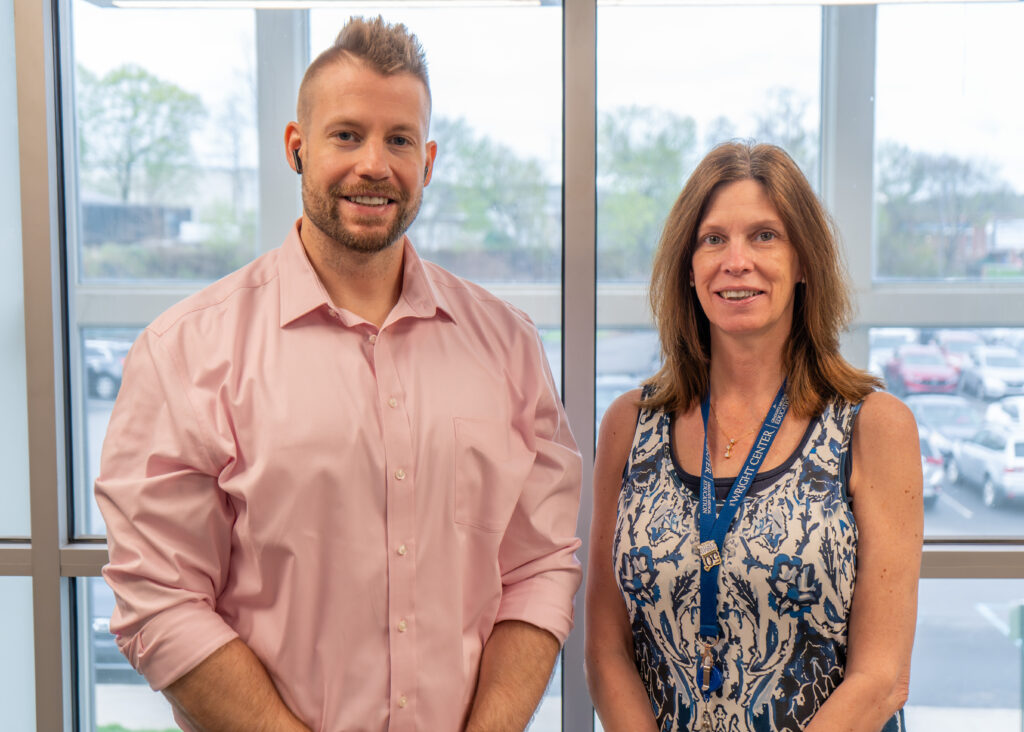
Stephen Bennett, a senior financial analyst, and Eileen Howells, the designated institutional administrator, qualified for a student loan debt forgiveness program for individuals who work for qualifying nonprofit organizations and make at least 120 qualifying monthly payments – equivalent to 10 years.
When Eileen Howells graduated from Marywood University in 1996, she left with a Bachelor of Business Administration degree and $17,000 in student loan debt.
As she launched her career, got married, and started a family, she – like many Americans – had more than her share of financial worries. By the time Howells felt established enough to add her student loan to the list of bills she was paying monthly, the debt had grown to more than $34,000.
“It felt like something I’d never be able to pay off,” said our designated institutional administrator. “I thought I’d die before I finished making payments.”
Instead, Howells learned about a federal student loan forgiveness program for individuals who work for qualifying nonprofit organizations and make at least 120 qualifying monthly payments – equivalent to 10 years. She teamed up with Savi, a financial advisor affiliated with TIAA and available through our human resources department, to begin completing the paperwork required to qualify for the program.
Savi’s student loan experts have helped our employees in a variety of ways, according to Nicole Miller, our director of compensation and benefits. In addition to helping employees reduce monthly payments based on income and family size, the service helps determine eligibility for more than 150 state and federal loan forgiveness programs and handles all paperwork, certifications, and more.
The success rate for borrowers reaching forgiveness on their own has been just 2.6% since November 2020, according to Education.org’s 2022 report on student loan forgiveness statistics. Miller said providing a resource like Savi to help colleagues navigate the complexities of loan reduction and forgiveness programs is deeply rewarding.
“Savi has been a valuable resource for our colleagues, and I’m happy every time I hear about a success story,” Miller said, noting she paid her student loans off in April 2026, after 22 years. “Unfortunately, I’m all too familiar with the huge burden student loans can be.”
That was certainly the case for Howells. Despite making monthly payments for about 15 years, her loan balance didn’t seem to dwindle much.
“I never missed a payment, and that $34,000 only shrunk to $28,000,” Howells said. “I paid and paid, and it never felt like I was making any real progress.”
Stephen Bennett, one of our senior financial analysts, had a similar experience. He graduated from Bloomsburg University in 2010 with $52,000 in student loan debt. He began making monthly payments between $200 and $500 shortly after graduating, but, like Howells, his loan continued to loom.
“I was on an income-driven repayment plan,” he said. “While manageable, the payments were a long-term financial commitment and often felt like they were only keeping pace with interest rather than reducing the principal balance.”
Like Howells, Bennett began working for us in 2015. Both said they continued working here because they believed in our mission and found their jobs fulfilling. Having an opportunity to relieve the burden of seemingly unending student loan payments was a much-welcomed perk.
As they approached the 10-year mark required for federal student loan forgiveness, Savi experts guided Howells through completing and submitting the necessary paperwork each year, while Bennett managed the process independently. Howells remained skeptical that she would actually qualify in the end, and Bennett experienced a delay after he changed his repayment plan to lower his monthly payments.
In January 2026, both received confirmation that their remaining student loans were forgiven. Howells joked about printing and framing the confirmation email as proof of her long journey. Bennett said receiving the “golden email” was a relief.
“While the process took longer than expected due to delays, I’m extremely grateful for the opportunity,” he said. “It truly felt like a case of better late than never, and it lifted a significant financial and emotional burden.”
Financial help for students and graduates
Our Human Resources team can help connect you to resources to help you pay for your education, no matter the stage. Here are some of the programs we participate in. Check with Nicole Miller, our director of compensation and benefits, for more information, including eligibility:
Loan repayment programs:
- The Health Resources and Services Administration (HRSA) National Health Service Corps (NHSC) Loan Repayment Program
- HRSA NHSC Rural Community Loan Repayment Program
- HRSA NHSC Substance Use Disorder (SUD) Workforce Loan Repayment Program
- Nurse Corps Loan Repayment Program
- Pediatric Specialty Loan Repayment
- Pennsylvania Primary Care Loan Repayment Program
- Pennsylvania SUD Loan Repayment Program
- Public Service Loan Forgiveness
- Substance Use Disorder Treatment and Recovery Loan Repayment Program
Tuition assistance:
- Financial support for the National Institute for Medical Assistant Advancement training.
- 15% tuition discount for employees and their spouses pursuing specific graduate programs at the University of Scranton.
Interested in seeing how Savi can help you with student loan debt relief, including reducing your payments and assessing eligibility for state and federal student loan forgiveness programs? Visit www.TIAA.org/thewrightcenter/student to get started.