‘Pass the torch:’ Sister of Mercy reflects on a lifetime of caring for the community
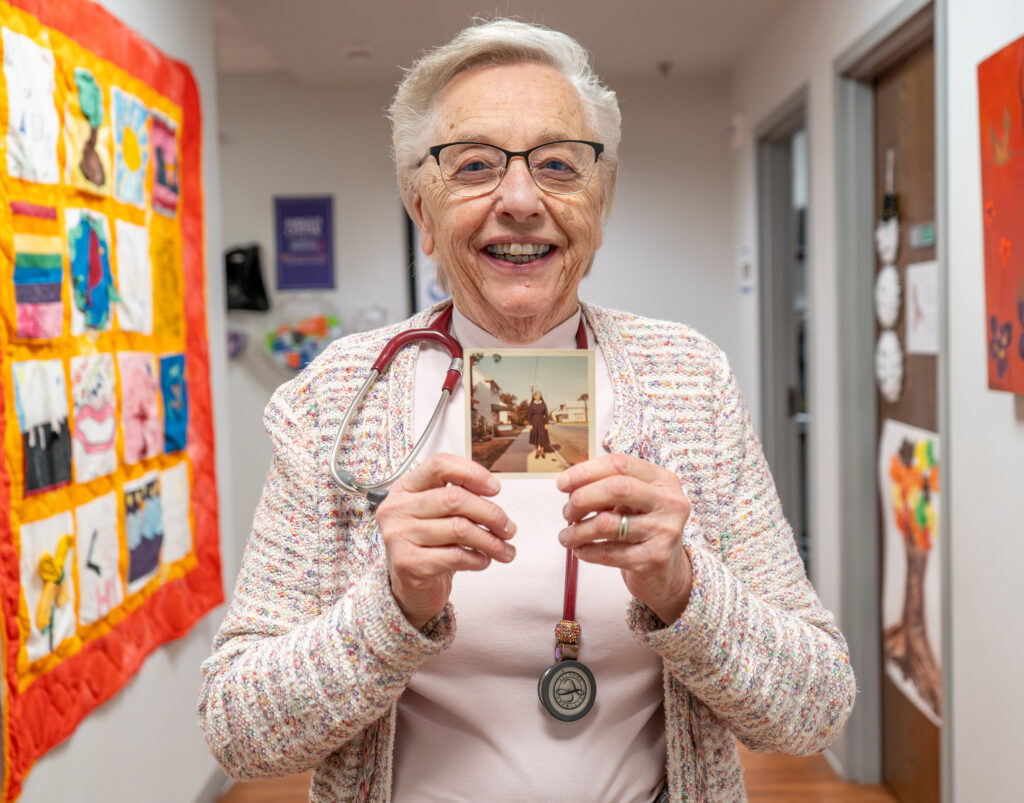
Sister Ruth Neely, a certified nurse practitioner at The Wright Center for Community Health’s Ryan White HIV/AIDS Clinic, holds a photo of herself in her habit in the late 1960s, just before she took her final vows for the Religious Sister of Mercy.
At 51, and newly graduated from College Misericordia’s nurse practitioner program in 1996, Sister Ruth Neely faced an unfamiliar challenge: finding a job.
A Religious Sister of Mercy (RSM) who had worked in health care since the late 1960s, she wrote to Robert E. Wright, M.D., FACP, a visionary physician who founded what was then the Scranton-Temple Residency Program to train doctors and expand access to primary care throughout the region. The response launched a new chapter for Sister Ruth – pioneering HIV and AIDS care in Scranton.
Three decades later, the singing sister and two-time breast cancer survivor announced her retirement as a certified nurse practitioner at The Wright Center for Community Health’s Ryan White HIV/AIDS Clinic. As part of National Nurses Month, celebrated each May, she reflected on her long career serving communities in Northeast and Central Pennsylvania.
“It’s time to pass the torch,” she said. “I’m retiring, but I won’t be bored. There’s still plenty to do.”
‘They saw a gift in me’
Growing up in Duncansville, Blair County, Pennsylvania, Sister Ruth never considered a religious life. A presentation at church inspired the dedicated Girl Scout and accomplished softball player.
“They were asking about the kind of life we wanted to lead,” Sister Ruth said. “I thought, ‘I want to be a nun.’”
She entered the Sisters of Mercy convent in 1963 at age 19 and took her final vows in 1970. Founded in Ireland by Catherine McAuley, the order is dedicated to serving people experiencing poverty, illness, or lack of educational opportunity.
Those principles – which include visiting the sick and imprisoned, feeding the hungry, burying the dead, comforting the sorrowing, counseling the doubtful, and more spiritual and corporal works of mercy that she keeps at her desk – have guided Sister Ruth for more than 60 years.
“I journey with all of my patients,” she explained. “My life’s work has been living my vows, especially my fourth vow to care for the underserved and vulnerable. That has been my purpose.”
Around the time Sister Ruth became a nun, widespread changes in health care sparked a growing need for skilled health care providers to care for aging nuns in the convents.
“Sister William Joseph, the head of our RSM locally, knew she had to educate someone to care for the elderly nuns,” Sister Ruth recalled. “They saw a gift in me.”
Always at the RSM’s direction, Sister Ruth grew as a caregiver. After beginning her career as a licensed practical nurse in 1971 at St. Mary’s Convent and St. Mary’s Hospital in Scranton, she moved to Johnstown in 1973 to work as a registered nurse in the emergency department at Mercy Hospital. Two years later, she became director of nursing at the Cambria County Nursing Care Center.
In 1980, she followed the RSM’s calling and relocated to Northeast Pennsylvania to serve as the coordinator and director of health services for Mercy Center on the campus of today’s Misericordia University, to care for the order’s growing number of aging nuns.
“Caring for the sick and elderly nuns means so much to me,” she said. “I was proud to be present with them as they made their final journeys.”
Throughout her long career, her joyful spirit has buoyed the communities she’s served in other, less tangible ways. Her colleagues and patients have described how she sings snippets of songs as she works, bringing unexpected smiles. She has performed at casual events and with choirs throughout her life, including as the only actual nun in a Diocese of Scranton-affiliated Sister Act-style musical revue that performed across the region, including an early 2000s appearance at the Scranton Cultural Center.
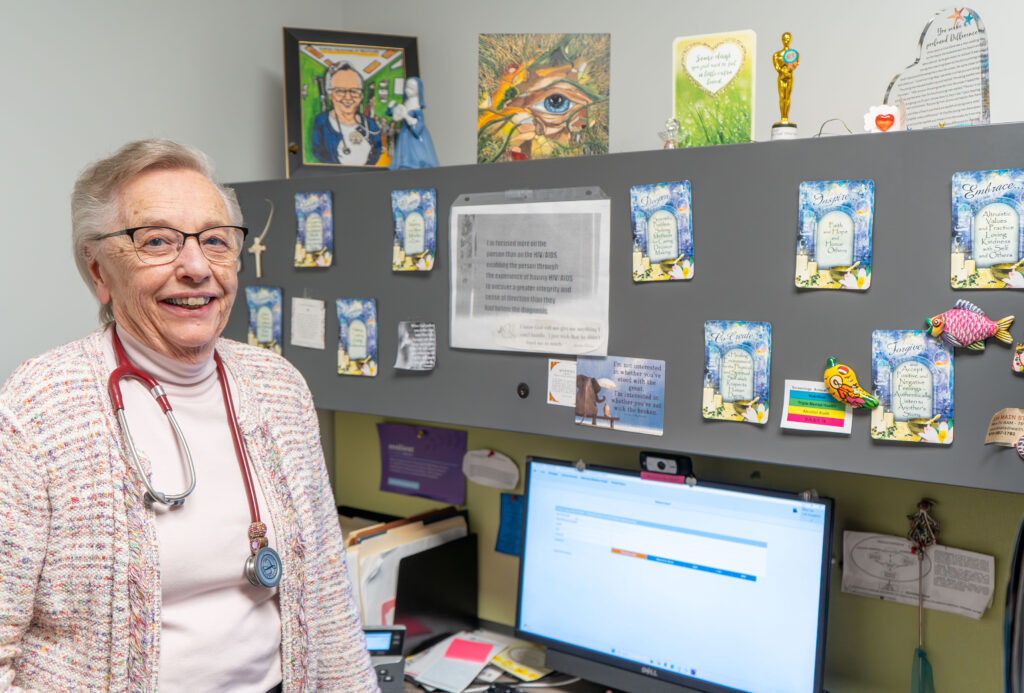
Sister Ruth Neely, a certified nurse practitioner at The Wright Center for Community Health’s Ryan White HIV/AIDS Clinic, surrounds herself with reminders of her work and her faith.
‘Caring for people’
In the early 1990s, the sister took on a new challenge – joining Misericordia’s first class of students working toward certification as nurse practitioners.
“I graduated in 1996 and, all of a sudden, I had to find a job,” she said. “I knew I wanted to work for a Mercy-sponsored facility, and I knew I wanted to work in primary care.”
Again, timing was on Sister Ruth’s side. Her introductory letter to Dr. Wright, dated Aug. 13, 1996, coincided with a huge shift in how HIV and AIDS were treated – thanks to the introduction of medications that transformed a death sentence into a manageable condition.
Sister Ruth began working side-by-side with infectious disease expert Stephen Pancoast, M.D., who was recruited to the area by Dr. Wright in the late 1970s. As HIV drugs began rolling out, there was a need for health care professionals to focus on medication adherence.
Patients had to take several medications throughout the day, each with its own specific rules about when and how to take it, Sister Ruth said. Side effects were common and required management. And then there were all the other ways patients needed help – from basic needs like food, housing, and utility bills, to transportation, emotional support, and more. Sister Ruth and her colleagues helped with all of it.
Later, she worked closely with others who continued that critical work, including Shubhra M. Shetty, M.D., and Mary Louise Decker, M.D., FACP, FIDSA.
“My work is caring for people and offering what I call CPR: compassion, presence, and reassurance,” she said, noting the letter she wrote announcing her retirement put it best. “What an honor and a benefit it has been to work alongside extremely talented and supportive colleagues.”
Additionally, Sister Ruth found opportunities to get involved in community outreach in her role at Mercy Hospital in Scranton – partnering with community groups to care for incarcerated individuals, domestic violence survivors, needy children and mothers, and more. Lisa Baumann, who served as the regional director of community health services at Mercy Hospital and supervised Sister Ruth in the late 1990s, said the sister’s focus on the whole patient came as local and national health care leaders were realizing prevention was just as essential as treatment.
“Sister Ruth would do anything to help a patient,” Baumann recalled. “She would meet patients where they were, and she would work to provide what each person needed.”
One of Sister Ruth’s longtime friends, Sister Marie Parker, said the Sisters of Mercy have always been known as “the walking nuns” who went out into the streets to minister to anyone who needed them.
“Unlike a lot of orders, we were never cloistered,” Sister Marie said. “She visited patients wherever they were, and she didn’t hesitate to do what needed to be done to give them the best care, medically and spiritually.”
Dr. Wright, the namesake founder of The Wright Center, also praised Sister Ruth’s tireless advocacy for her patients. He credited her compassionate work with Dr. Pancoast as one of the reasons The Wright Center is the home of the U.S. Health Resources and Services Administration-designated Ryan White Clinic.
Today, the clinic provides care to nearly 500 patients annually from Lackawanna, Luzerne, Monroe, Pike, Susquehanna, Wayne, and Wyoming counties at its teaching health centers in Scranton and Wilkes-Barre. More than 96% of the clinic’s patients have undetectable viral loads, meaning they cannot transmit HIV to others and their immune systems will remain intact and not be harmed by the virus.
When patients reach that milestone, Sister Ruth will sing a few bars of Nat King Cole’s classic to them, substituting “undetectable” for “unforgettable” in her lyrics.
‘Beautiful fabric’
Sister Ruth also takes pride in working with hundreds of physician learners and students pursuing a wide range of health care careers, modeling her compassionate, whole-person approach to care. In one full-circle moment, a 2005 graduate of The Wright Center for Graduate Medical Education’s Internal Medicine Residency Program, Kristin M. Liptock, D.O., later cared for Sister Ruth during her second battle with breast cancer in 2015. Dr. Liptock is an oncologist with Hematology and Oncology Associates in Dunmore.
Until her retirement in March 2026, Sister Ruth maintained a busy work schedule, spreading gentle joy and delivering high-quality care at the Ryan White Clinic and across the region. Most people she encountered each day came away with a small token – a printed prayer, an inspirational quote, or a little red heart – to remind them of her love and faith.
“Sister Ruth greets all patients with a warm smile, and many do not leave the clinic without a hug from her,” said Dr. Decker, who leads the Ryan White Clinic and serves as the infectious diseases medical director at The Wright Center. “I will miss everything she brings to the clinic, especially the lively conversations we had while eating lunch.”
Even decades later, Sister Ruth can name patients she cared for, colleagues she worked with, and health care professionals – from physician learners to nurses, case managers, and more – she helped train.
“It’s all part of the beautiful fabric of my life,” she said. “Everything that has been accomplished, I’ve been part of a team. None of it was on my own.”