Lake Erie College of Osteopathic Medicine students, from left, are Sulav Shrestha, Tazeen Malik, Katherine Weir, and Elena Myalo.
The Wright Center for Community Health welcomed four medical students from the Lake Erie College of Osteopathic Medicine (LECOM), who will complete rotations at the nonprofit’s health centers and other locations throughout the region. This year marks the launch of the partnership between The Wright Center and LECOM, which is open to third- and fourth-year medical students. “The goal is to train these medical students in underserved communities, and hopefully, they will stay in Northeast Pennsylvania to complete their medical residencies after graduation,” said Carla Blakeslee, The Wright Center for Graduate Medical Education’s clerkships coordinator.
From left, Community Health Worker Harry Yanoshak; Nicole Lipinski, director of The Wright Center’s Geriatric Service Line; Kathleen Doyle, director of patient-centered services; Community Health Worker Kristin Zaorski, and Lou Strazzeri, community and agency referrals coordinator, at The Wright Center for Community Health – Mid Valley.
Two new community health workers (CHWs) are offering specialized services to patients at The Wright Center for Community Health and residents of Northeast Pennsylvania, thanks to a unique program through the National Health Corps (NHC).
Harry Yanoshak of Plains Township to work with The Wright Center’s geriatric care teams and Kristin Zaorski of Covington Township will collaborate with The Wright Center’s behavioral health teams.
Both CHWs are funded through the NHC’s Community Health Fellowship, a grassroots community health service program that trains local community residents as CHWs. The new employees are committed to addressing the unmet needs of underserved populations and honing their skills as community health leaders.
The Wright Center employs CHWs to help connect patients and community members to various resources. In addition to connecting them to food pantries and helping them find safe, affordable housing, CHWs can also help patients address utility bills, transportation to and from doctor’s appointments, health insurance applications, and a variety of other needs.
“They bridge the gap,” said Kathleen Doyle, director of patient-centered services at The Wright Center. “They help address basic needs so patients can focus on their health and medical needs. This ties in directly to The Wright Center’s mission.”
The NHC program funds CHWs to work in specialized areas to facilitate integration with The Wright Center for Community Health’s whole-person primary health services.
“This is one more step in offering whole-person, integrated care,” said Lou Strazzeri, community and agency referrals coordinator for The Wright Center. “We can now offer a CHW who can focus specifically on what a patient being seen by our geriatric care team might need or what one of our behavioral health patients may need.”
Nicole Lipinski, director of The Wright Center’s Geriatric Service Line, looks forward to the unique resources and support Yanoshak will be able to offer to patients and their families.
“We are able to help this vulnerable population navigate through the care continuum as they age in place or require additional assistance with care in facilities,” she said. “Having a CHW will only enhance what we can offer.”
CHWs are one of the fastest-growing occupations in today’s health care field, with a projected 12% increase in jobs between 2021 and 2031, according to the U.S. Bureau of Labor Statistics.
Participants in the AmeriCorps-funded NHC program must complete 1,700 hours of service within a term spanning 42-46 weeks. They also must complete a CHW training course offered by the Northeast Pennsylvania Area Health Education Center. They receive a living stipend and are eligible for food and child care assistance, tuition reimbursement, and access to health insurance, including medical, vision, and dental.
The Wright Center, headquartered in Scranton, operates 10 primary and preventive care practices in Northeast Pennsylvania, including a mobile medical and dental vehicle called Driving Better Health. Its locations offer integrated whole-person primary health services, meaning patients typically have the convenience of going to a single location to access medical, dental, and behavioral health care, as well as community-based addiction treatment and recovery services. For more information, go to TheWrightCenter.org or call 570-230-0019.
Dr. Kristina Tanovic, a board-certified internal medicine hospitalist at The Wright Center for Community Health, has been elected a fellow of the American College of Physicians (ACP), the society of internists. The distinction recognizes achievements in internal medicine, the specialty of adult medical care.
Dr. Tanovic was elected upon the recommendation of peers and the review of ACP’s Credentials Subcommittee. She may now use the letters “FACP” after her name in recognition of this honor.
Dr. Tanovic sees patients of all ages at The Wright Center for Community Health – Scranton Counseling Center, 329 Cherry St., where she is accepting new patients. Certified by the American Board of Internal Medicine and the American Board of Obesity Medicine, Dr. Tanovic is also a core faculty member of The Wright Center for Graduate Medical Education’s Internal Medicine Residency, where she trains the physicians of tomorrow. The Wright Center’s residency and fellowship programs are accredited by the Accreditation Council for Graduate Medical Education.
Kristina Tanovic, M.D., FACP
A graduate of the University of Belgrade School of Medicine in Serbia, Dr. Tanovic completed her internal medicine residency at Icahn School of Medicine at James J. Peters VA Medical Center, a Mount Sinai School of Medicine-affiliated facility in the Bronx, New York.
Dr. Tanovic and her husband, Dr. Ivan Cvorovic, live in Scranton, with their daughter Iskra Cvorovic.
ACP is the largest medical specialty organization and the second physician group in the United States. ACP members include 143,000 internal medicine physicians, related subspecialists, and medical students. Internal medicine physician are specialists who apply scientific knowledge and clinical expertise to the diagnosis, treatment, and compassionate care of adults across the spectrum from health to complex illness. For more information about ACP, go to acponline.org.


Dr. Ivan Cvorovic, a board-certified internal medicine hospitalist at The Wright Center for Community Health, has been elected a fellow of the American College of Physicians (ACP), the society of internists. The distinction recognizes achievements in internal medicine, the specialty of adult medical care.
Dr. Cvorovic was elected upon the recommendation of peers and the review of ACP’s Credentials Subcommittee. He may now use the letters “FACP” after his name in recognition of this honor.
Dr. Cvorovic sees adult patients at The Wright Center for Community Health – Scranton Counseling Center, 329 Cherry St., where he is accepting new patients. Certified by the American Board of Internal Medicine, Dr. Cvorovic is also a core faculty member of The Wright Center for Graduate Medical Education’s Internal Medicine Residency, which is accredited by the Accreditation Council for Graduate Medical Education.
Ivan Cvorovic, M.D., FACP
A graduate of the University of Belgrade School of Medicine, Dr. Cvorovic completed his internal medicine residency training at Icahn School of Medicine in New York, where he served as the chief resident.
Dr. Cvorovic and his wife, Dr Kristina Tanovic, live in Scranton, with their daughter Iskra Cvorovic.
ACP is the largest medical specialty organization and the second physician group in the United States. ACP members include 143,000 internal medicine physicians, related subspecialists, and medical students. Internal medicine physicians are specialists who apply scientific knowledge and clinical expertise to the diagnosis, treatment, and compassionate care of adults across the spectrum from health to complex illness. For more information about ACP, go to acponline.org.
An alumnus who works as a University of Pennsylvania hospitalist and clinical instructor will be the keynote speaker for The Wright Center for Graduate Medical Education’s 45th graduation ceremony on Saturday, June 22, at Mohegan Pennsylvania Convention Center in Wilkes-Barre.
The Wright Center’s graduation ceremony will honor and recognize 67 resident physicians from seven disciplines: 32 in Internal Medicine; 14 in Regional Family Medicine; 16 in National Family Medicine; one in Psychiatry; one in Cardiovascular Disease; two in Geriatrics; and one in Gastroenterology.
Keynote speaker Dr. Humza Quadir of Philadelphia graduated from The Wright Center’s Internal Medicine Residency in 2022. He joined the staff of Penn’s Perelman School of Medicine and is also affiliated with the Hospital of the University of Pennsylvania and Penn Presbyterian Medical Center.
At The Wright Center, Dr. Quadir served in several leadership roles, including chief resident during the final year of his three-year residency. He also served as vice president of the house staff council, a voting member of the Graduate Medical Education Committee (GMEC), and a member of GMEC’s Quality and Safety Committee. Dr. Quadir received his medical degree from Ziauddin University in Karachi, Pakistan, in December 2014.
“Dr. Quadir is a leader who understands the importance of our mission ,” said Dr. Jumee Barooah, senior vice president of education and designated institutional official for The Wright Center for Graduate Medical Education. “He’s carried those same values to his roles as a hospitalist and clinical instructor. We’re looking forward to hearing the wisdom he will impart to our graduates as they embark upon the next chapter of their careers.”
Dr. Humza Quadir
The Wright Center for Graduate Medical Education was established in 1976 as the Scranton-Temple Residency Program, a community-based internal medicine residency. Today, The Wright Center is one of the largest U.S. Health Resources and Services Administration-funded Teaching Health Center Graduate Medical Education Safety-Net Consortiums in the nation.
The Wright Center for Graduate Medical Education’s residency and fellowship programs are accredited by the Accreditation Council for Graduate Medical Education. For more information, go to TheWrightCenter.org or call 570-866-3017.
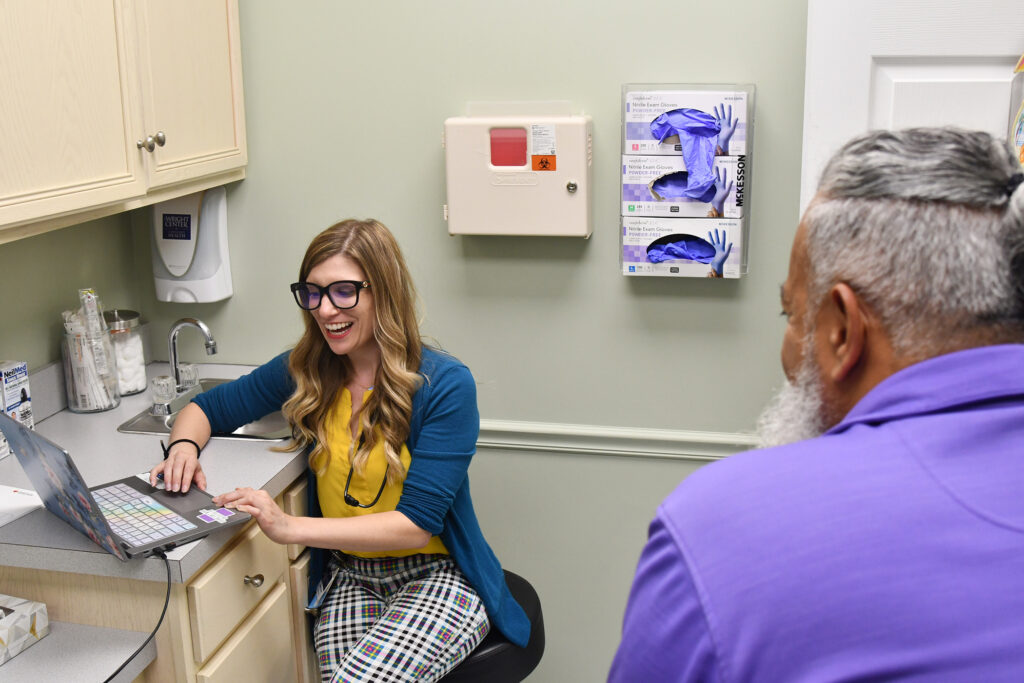
Dr. Erin McFadden, center, collaborates with Dr. Ketaki Pande, a resident physician in The Wright Center for Graduate Medical Education’s Internal Medicine Residency, during an examination with patient Nicole Ammons at The Wright Center for Community Health – North Scranton. Drs. McFadden and Pande see patients together as part of The Wright Center’s new program that places medical residents on care teams to elevate the standard of care for all patients.
The Wright Centers for Community Health and Graduate Medical Education have launched an innovative program to enhance patient care while nurturing the skills of tomorrow’s physician workforce.
Medical residents at The Wright Center for Graduate Medical Education are now members of “care teams” that provide whole-person primary health services to people of all ages, income levels, and insurance statuses. The novel initiative elevates the standard of care provided at The Wright Center’s nine community health center locations in Northeast Pennsylvania while providing a platform for residents to refine their skills as compassionate healers.
By seamlessly integrating hands-on experience with comprehensive training, the program embodies The Wright Center’s mission.
“Patients get two sets of eyes – the resident and the doctor,” said Dr. Timothy Burke, a primary care physician at The Wright Center for Community Health – Mid Valley in Jermyn, Pennsylvania, and the associate program director of The Wright Center for Graduate Medical Education’s Internal Medicine Residency. “Seeing the same resident and the same doctor each time means the patient doesn’t have to repeat their medical history over and over. Both know who you are, the care you’re receiving, and the obstacles you face.”
Patients will benefit from building personal relationships with The Wright Center’s resident physicians, according to Dr. Erin McFadden, a primary care doctor who also serves as deputy chief medical officer and medical director of The Wright Center for Community Health’s locations in Scranton, North Scranton, and the Scranton Counseling Center.
“That’s the beauty of primary care. It’s not just learning the medicine, it’s learning how to develop the relationship with the patient,” Dr. McFadden said. “It’s important to build that patient-doctor trust so you can see how their health is changing and, hopefully, improving.”
Dr. McFadden, for example, said a resident physician will prescribe a patient with diabetes a particular drug to help with blood sugar levels. Now, as part of the patient’s care team, they can monitor how effective that medication is – and what side effects the patient may or may not experience – at subsequent appointments.
The Wright Center recently launched the care team model to enhance the delivery of whole-person primary health services to patients while nurturing the skills of tomorrow’s physician workforce. Internal Medicine resident physician Dr. Ketaki Pande, left, examines patient Nicole Ammons as Dr. Erin McFadden monitors the patient visit.
“We’re giving an opportunity to our patients and our resident physicians to build a relationship,” she said. “If you want to take care of a disease and improve health, you need multiple pictures over time to watch cause and effect.”
The care team concept is not new at The Wright Center for Community Health, which typically integrates medical, dental, and behavioral health care, as well as community-based addiction treatment and recovery services, at a single location for the convenience of patients. To ensure residents could become more involved in patient care teams, The Wright Center collaborated with its Electronic Health Record (EHR) vendor to redesign the scheduling of patient appointments to honor patient continuity.
The program also means changing the way resident physicians are scheduled for rotations, which are completed at The Wright Center’s community health centers, local hospitals, and other medical settings in the region. Typically, resident physicians cycle through a number of assignments, each lasting a few weeks to a month. Now, the residents who are part of the new care teams are assigned to their doctor’s clinic location once a week.
“That came from a buy-in across the medical residency program leaders that continuity was important and a priority, so no other rotations were going to supersede their regularly scheduled continuity clinics,” said Tiffany Jaskulski, vice president of health innovation and strategic initiatives at The Wright Center.
First-year Internal Medicine resident Dr. Ketaki Pande sees patients at The Wright Center for Community Health – North Scranton on Fridays with Dr. McFadden. She’s enjoyed getting to know patients on a deeper level and says the team approach is helping her become a more effective physician.
“One of the big parts of primary care is managing chronic conditions,” Dr. Pande said. “For example, not everyone responds to a particular medication the same way. So, I prescribe something, and now I can follow up weeks and months later, to see how it’s working and if something else is needed.”